Installing solar panels on a vertical wall is an interesting option for generating energy. But be careful, there are rules to follow. It’s not just a matter of fixing panels, you have to think about safety, authorisations, and how it all fits together. We’ll look together at what you need to know to ensure your project goes smoothly, without any nasty surprises. It’s a bit technical, but we’ll try to make it clear.
Key Points to Remember
- The installation of solar panels on a vertical wall is subject to electrical safety standards (NF C 15-100, NF EN 62446, NF C 14-100) and must guarantee the resistance of the panels (NF EN 61215, NF EN 61646 for photovoltaic, NF EN 12975-1 for thermal).
- Depending on the municipality, a prior declaration of works or a building permit may be required, especially in protected areas. You must inquire at the town hall.
- For facade installation, safety distances must be observed from windows (at least 2 metres) and smoke vents, and materials must have appropriate fire behaviour.
- The solidity of the installation is paramount. A certificate of good installation, a check of resistance to pull-out by an expert, and sometimes cold strength are required.
- Using an RGE (Reconnu Garant de l’Environnement) certified installer is often mandatory to benefit from financial aid and guarantees the quality of the work.
Regulatory Framework for Installing Solar Panels on a Vertical Wall
The installation of solar panels on a vertical wall, although less common than on a roof, is subject to a set of technical and safety rules. These regulations aim to ensure the safety of people, the performance of installations, and the protection of the built environment.
Essential Electrical Safety Standards
Electrical safety is paramount for any photovoltaic installation. In France, several standards must be scrupulously followed. The NF C 15-100 standard governs low-voltage electrical installations, including cabling and protection downstream of the circuit breaker. For connection to the public distribution network, the NF C 14-100 standard applies. Furthermore, the NF EN 62446 standard details the procedures for checking and commissioning solar systems to ensure their proper functioning and safety. These standards are in place to prevent fire and electrocution risks.
Panel Resistance and Performance Criteria
Solar panels installed on facades must not only be efficient but also withstand environmental stresses. For photovoltaic panels, NF EN 61215 (for crystalline silicon) and NF EN 61646 (for thin films) define the performance and durability criteria. It is also important to consider the mechanical resistance of the fixings, which must support the loads from wind and the weight of the panels. Although the ideal tilt angle for energy production is generally between 25 and 35 degrees, a vertical installation remains a viable option for solar energy production [3219].
Compliance of Installations with Specific Standards
Beyond electrical and panel performance standards, other regulations apply. For example, safety distances must be observed from glazed areas (at least 2 metres) and smoke vents (at least 2 metres vertically above). The fire behaviour of photovoltaic materials is also an important criterion, which must at least meet the requirements for non-dripping materials (class d0). For solar thermal panels, the NF EN 12975-1 standard applies, distinguishing them from photovoltaic installations.
It is imperative to consult your municipality’s Local Urban Plan (PLU), as specific rules may be added, particularly concerning the aesthetic appearance of installations in protected areas.
Urban Planning Authorisations for a Vertical Installation
Prior Declaration of Works
For most vertical solar panel installations, a prior declaration of works is the minimum requirement. This administrative procedure informs the town hall of your project and allows them to verify its compliance with local urban planning rules. It is generally sufficient for installations that do not significantly alter the external appearance of the building or encroach on public space. It is important to correctly complete the corresponding Cerfa form and attach all requested documents, such as location plans and project visuals.
Building Permit: When is it Required?
A building permit becomes necessary in certain more specific cases. If your photovoltaic installation, once mounted on the wall, exceeds a certain size or significantly alters the structure or appearance of your house, a building permit may be required. This is often the case for very large installations or those involving significant structural modifications. The exact threshold may vary, but it is always best to check with your town hall to avoid any irregularities. It is essential to check local urban planning rules before starting work.
Specific Cases of Listed and Protected Areas
The installation of solar panels on a vertical wall in protected areas, such as listed sites, the vicinity of historical monuments, or protection perimeters, is subject to stricter rules. In these cases, the opinion of the Architecte des Bâtiments de France (ABF) is often required. They may impose constraints on the type of panels, their colour, their arrangement, or even their feasibility. A prior declaration may be sufficient for low-power installations (< 3 kWp) in these areas, but as soon as the power increases, a building permit becomes the norm, with particular attention paid to visual and heritage impact. Therefore, potentially longer and more complex procedures should be anticipated in these sensitive sectors.
Installation and Facade Placement Principles
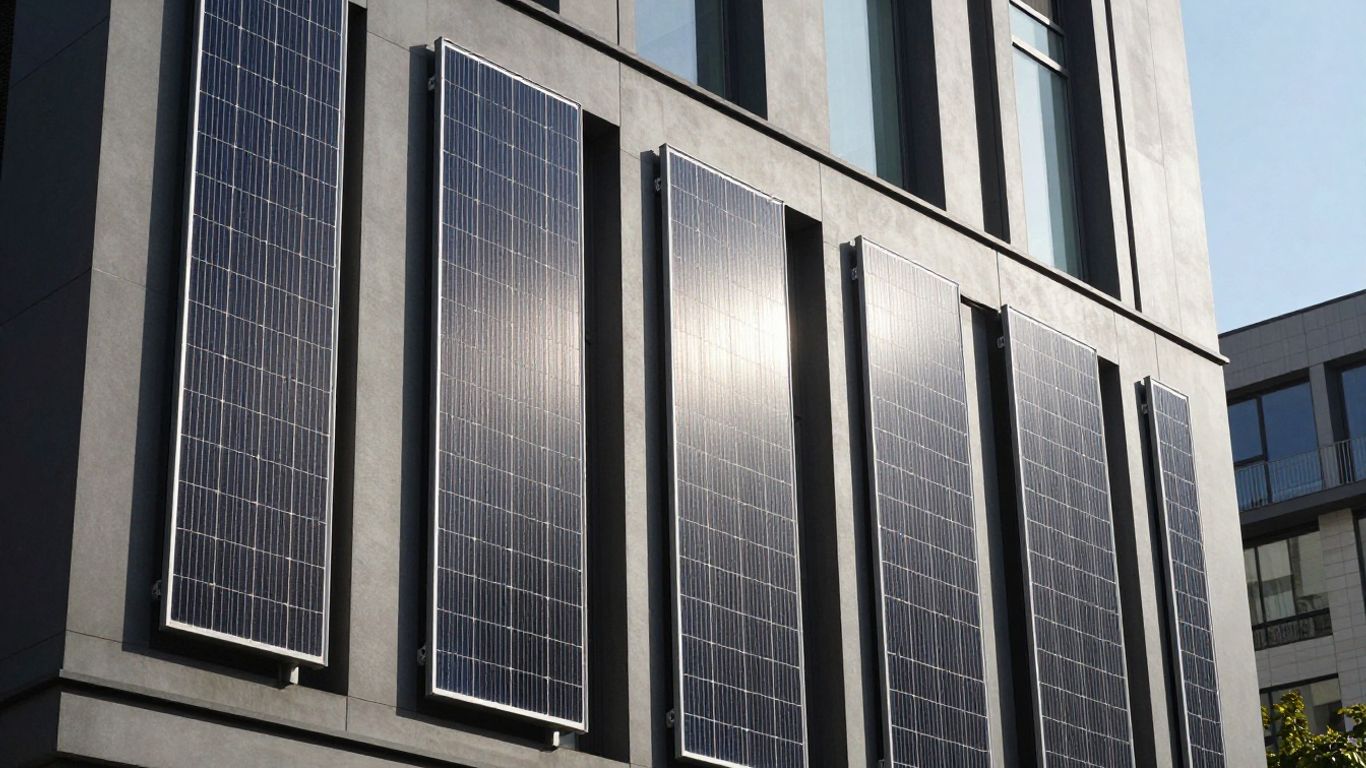
Installing solar panels on a facade requires particular attention to ensure both the safety of people and the efficiency of the system. It is not simply a matter of fixing panels to a wall; several technical and safety rules must be followed.
Safety Distances from Glazed Areas
To prevent any electrical risk, particularly with direct current, a minimum distance must be observed between the components of the photovoltaic installation and openings (windows, French doors) on the facade. This distance is set at 2 metres. This helps to limit people’s exposure in case of an insulation fault and to facilitate intervention by emergency services.
Requirements for Smoke Vents
Smoke vents, essential for smoke evacuation in case of fire, are subject to specific rules. A minimum vertical distance of 2 metres must be maintained between these vents and any conductive element of the photovoltaic installation located above them. This provision aims to avoid hindering the proper functioning of the smoke extraction system.
Fire Behaviour of Photovoltaic Materials
Fire safety is a major concern. The materials used for solar panels and their mounting structure must exhibit appropriate fire behaviour. They must at least meet the requirements for so-called « non-dripping » materials, which corresponds to an additional classification of d0. This means they must not produce flaming droplets that could spread fire. For supporting structures, a minimum fire classification of B-s3, d0 is often required, depending on the type of installation and the building concerned. It is important to research the specifics of integrating solar panels into facades to choose appropriate materials.
It should also be noted that the installation can slightly increase the ambient temperature of the facade, due to sometimes restricted air circulation. This point should be considered during project design, especially in hot regions. This temperature increase is a factor to consider for the durability of materials and the comfort of the building.
Solidity and Resistance of Wall-Mounted Solar Panels
Installing solar panels on a facade is not limited to simply fixing them. It is imperative to ensure their solidity and resistance to the elements and time. This guarantees not only the safety of people and property but also the longevity of your installation.
Certificate of Good Installation and Fixing
At the end of the work, the installer must provide a certificate of good installation. This document certifies that the panels are correctly fixed and resistant to pull-out. It is formal proof that the installation complies with best practices and current standards. This certificate covers the proper fixing of the panels to the supporting structure or directly to the building elements that support them.
Cold Strength Verification by an Expert
Beyond the installation certificate, a cold strength verification may be required. This expertise, carried out by a qualified professional or an accredited body, assesses the ability of the entire installation to withstand mechanical stresses (wind, snow, etc.) without deformation or damage, even before commissioning or in the absence of energy production. This is an important step for installations exposed to harsh weather conditions.
Resistance to Pull-Out of Panels
Resistance to pull-out is a critical point, especially in windy areas. The fixing systems must be designed to withstand the forces exerted by the wind, which can be considerable. The certificate of good installation must specifically state that this resistance has been taken into account and validated. It is advisable to research vertical mounting options, whether fixed or variable tilt, to best suit your facade vertical mounting options.
It is essential that the materials used for fixing are suitable for the nature of the wall and the local environmental conditions. Improper fixing can lead to significant material damage and pose a danger.
Standards such as NF EN 61215 for crystalline silicon photovoltaic modules or NF EN 61646 for thin films, while relating to performance, also imply a certain robustness of the panels themselves. Solar thermal panels, on the other hand, must comply with NF EN 12975-1, which also addresses their structural resistance.
Grid Connection and Electrical Compliance

NF C 14-100 Standard for Connection
Once your solar panels are installed on the wall, the next, and by no means least, step is to connect them to the electrical grid. This is a regulated step that requires following precise guidelines. The NF C 14-100 standard is the main reference for connecting electrical installations to the public distribution network. It details the technical requirements for your installation to be safe and compatible with the existing grid. This concerns, in particular, how cables are routed, the protective devices to be installed, and the connection points. Compliance with this standard is fundamental for everyone’s safety and for the proper functioning of your system.
Consuel Photovoltaic Compliance Certificate
After installation, it is imperative to obtain a compliance certificate issued by Consuel (Comité national pour la sécurité des usagers de l’électricité). This independent body verifies that your installation complies with all current electrical safety standards, including those specific to photovoltaics. It’s a bit like a technical inspection for your solar installation. Without this certificate, you will not be able to commission your system or benefit from certain aid or sell your surplus electricity. The process generally involves a visit from a Consuel technician to inspect the installation. The installer can often handle this process for you.
Connection Request Procedure
The request for connection to the electricity grid is an administrative procedure carried out with the grid operator, most often Enedis. Several documents are usually required to complete the application:
- The urban planning authorisation (prior declaration or building permit).
- A location plan and a site plan of the installation.
- Photos of the photovoltaic installation.
- Proof of property ownership.
- Your installer’s certification.
Once the complete file has been submitted, the grid operator will review your request and provide a quote for the connection. After acceptance and completion of the connection works, your installation can be commissioned. It is also at this point that you can finalise a contract with EDF OA (Obligation d’Achat) if you wish to sell your surplus production. The process can take several weeks, so it is advisable to start in advance.
Connecting to the public grid not only allows you to inject surplus electricity that you do not consume, but it also ensures a continuous electricity supply when your solar production is insufficient. It is a key element for optimised energy autonomy.
Certifications and Professional Qualifications
When investing in solar panels, especially for a wall installation which can have specificities, it is important to ensure that the company carrying out the work is competent. It’s not just about doing things correctly, but also about being able to benefit from financial aid and having peace of mind regarding the quality and safety of the installation. Fortunately, there are labels and certifications that help to clarify things.
RGE Labels for Installers
The Reconnu Garant de l’Environnement (RGE) label is a quality mark certifying that the company has undergone specific training for the work you are considering. It’s a bit like a guarantee that the professional knows their business. For many financial aids, such as MaPrimeRénov’ or certain self-consumption bonuses, using an RGE company is a mandatory condition. Without it, there are no aids. Therefore, it is important to check that your installer holds this label.
Importance of Certifications for Financial Aid
As mentioned, certifications play a key role in accessing financial aid. Beyond RGE, other labels such as QualiPV (offered by Qualit’EnR) or QualiSol (for solar thermal) are specifically dedicated to photovoltaic and solar thermal installations. The QualiPV label, for example, certifies that the company adheres to a strict quality charter regarding information, advice, and overall service, before, during, and after installation. There is also the AQPV (Alliance Qualité Photovoltaïque) label, which certifies the quality of solar installations. These certifications are therefore a guarantee of seriousness and an entry point to aid schemes.
Quality Assurance for Certified Professionals
Using a certified professional ensures that the installation will be correctly sized for your needs and that the panels will be optimally oriented to produce maximum energy. This concerns both the quality of the installation itself and the durability of the equipment. For example, the QualiPV 36 certification is specifically designed for companies committed to the quality of grid-connected photovoltaic installations. In summary, choosing a certified professional means investing in peace of mind and the long-term performance of your wall-mounted solar system.
Specific Considerations for Solar Thermal Panels
It is important to distinguish between solar thermal panels and photovoltaic panels, as their functions and the regulations governing them differ. While photovoltaic panels produce electricity, solar thermal panels are used to heat a fluid, usually water, using solar energy. This distinction is fundamental to understanding the applicable standards.
Differentiation from Photovoltaic
The main difference lies in the technology and use. Photovoltaic panels convert sunlight into electricity via semiconductor cells. Thermal panels, on the other hand, capture the sun’s heat to warm a heat transfer fluid. This fluid then circulates in a heating system or for domestic hot water production. There are also hybrid systems that combine both functions, but the specific regulations for each technology must be taken into account.
NF EN 12975-1 Standard
For solar thermal installations, the European standard NF EN 12975-1 is a key reference. It specifies the performance and safety requirements for solar thermal collectors intended for the production of hot water or heating. This standard ensures that the equipment is designed to operate reliably and safely, taking into account climatic conditions and materials used. Compliance with this standard is often a condition for benefiting from certain aid or for ensuring the quality of the installation.
Applicability of Specific Regulations
Solar thermal panel installations on vertical walls, although less common than facade photovoltaic installations, must comply with their own urban planning and safety rules. Regulations concerning placement, safety distances from openings, and structural resistance also apply, adapted to the nature of thermal equipment. It is always advisable to consult your municipality’s urban planning department to find out about local specifics. Installing solar panels on a vertical wall eliminates certain risks related to roof waterproofing, thus offering an interesting alternative for energy production without compromising the integrity of the building.
- Check compatibility with the existing heating system.
- Observe safety distances from windows and balconies.
- Ensure the solidity of the facade fixing.
The integration of solar thermal panels on facades requires particular attention to aesthetics and harmony with the building’s architecture. Local regulations may impose constraints on the type of panels or their arrangement to preserve the character of the place.
Management of Surfaces and Walkways
Limitation of Photovoltaic Field Surface Area
When installing solar panels on a facade, it is important to manage the space occupied by the panels themselves, known as « photovoltaic fields ». Regulations impose limits to avoid overloading structures and for safety reasons. Generally, the maximum surface area of a panel field must not exceed 300 m², and its length is limited to 30 metres. These fields must be separated from each other by dedicated zones.
Width of Safety Walkways
These separation zones, called walkways, are mandatory between different panel fields. They must have a minimum width of 0.90 metres. The objective is to allow access to technical equipment, but above all to create safety zones. These walkways must remain completely free of any photovoltaic equipment, except for cables which are permitted under certain conditions. It is forbidden to install dummy or decorative elements that could obstruct passage or maintenance. If a walkway is already provided for access to technical rooms on the roof, it can be used to separate solar fields, provided it meets the same free passage requirements.
Protection and Bundling of Cables
The electrical cables that run through these safety walkways must be managed carefully. They should be bundled as much as possible, minimising the number of bundling points. Furthermore, mechanical protection is necessary to prevent any physical damage to the cables. This ensures both the safety of the installation and the longevity of the components. Good cable organisation is also important to facilitate future interventions, whether for maintenance or repair. It should also be noted that the orientation of the panels can be designed to better match consumption needs, for example by orienting panels towards the east or west for better alignment with daily consumption peaks.
Rigorous management of surfaces and walkways is a key component of a safe and compliant wall-mounted solar installation. It ensures not only regulatory compliance but also contributes to the overall performance and ease of maintenance of the system.
Financial and Fiscal Aspects
Installing solar panels on a vertical wall, although technically feasible, raises financial and fiscal questions that are important to consider. These aspects can influence the overall profitability of your project and the associated administrative procedures.
Development Tax for Ground-Mounted Installations
It is important to note that the development tax primarily concerns ground-mounted installations. For solar panels installed on a vertical wall, this tax is generally not applicable, as it applies to new constructions or developments creating enclosed and covered areas. The tax base for ground-mounted photovoltaic farms is €10 per square metre of panels, to which municipal and departmental rates apply. Ancillary constructions, such as technical rooms, are taxed differently according to their floor area.
Financial Aid and Eligibility Conditions
Several aid schemes exist to encourage the installation of solar panels. From 1st October 2025, a reduced VAT rate of 5.5% will apply to the installation of solar panels with a power of less than 9 kWp. Other aids, such as local subsidies or guaranteed purchase tariffs for electricity fed into the grid, may be available. It is essential to inquire with the relevant bodies (local authorities, energy agencies) to find out the specific eligibility conditions for your situation and project. Obtaining these aids is often conditional on using RGE (Reconnu Garant de l’Environnement) certified professionals.
Selling Surplus Production
If your installation produces more electricity than you consume, you have the option to sell the surplus to the grid. The conditions for this sale, particularly the purchase tariff, are set by the Energy Regulatory Commission (CRE) and may vary. You can choose between an obligation to purchase (OA solaire) contract with EDF OA or another buyer, or sell your production on the wholesale market. The power of your installation and the type of contract chosen will directly influence the potential income from this sale. Good optimisation of your installation, particularly in terms of orientation and tilt, can maximise your production and therefore your potential income.
In Summary: What to Remember
Installing solar panels on a vertical wall is an idea that is gaining ground. We’ve seen that it requires careful consideration of your municipality’s urban planning rules, as they vary from place to place. You also need to think about safety standards, like NF C 15-100, to ensure everything is done correctly and safely. And don’t forget certifications, like RGE, if you want to be eligible for certain aid. In short, it’s feasible, but it requires research and careful project planning. It’s worth it for the environment and your wallet, but you can’t go into it blindly.
Frequently Asked Questions
What are the main rules for installing solar panels on a wall?
To install solar panels on a wall, you must comply with safety rules, especially for electricity. You also need to ensure that the panels are securely fixed and resistant to weather. Your municipality’s urban planning rules are also important.
Do I need to request authorisation to install solar panels on my wall?
Yes, most of the time. You generally need to submit a ‘prior declaration of works’ to your town hall. If the installation is very large or in a special location, a ‘building permit’ might be necessary. It’s always best to check with the town hall.
Are there any distances to respect from windows?
Absolutely. You must leave a space of at least 2 metres between the solar panels and windows or other openings on the wall. This is an important safety measure, especially regarding electrical risk.
How do I know if my installer is competent?
It is advisable to choose a professional who has RGE (Reconnu Garant de l’Environnement) certification. This label proves they have undergone special training and that their work is of high quality. It is often mandatory to receive financial aid.
Are solar thermal panels subject to the same rules as photovoltaic panels?
No, not entirely. Solar thermal panels are used to heat water, while photovoltaic panels produce electricity. They have different standards, such as NF EN 12975-1 for thermal, but some general rules may apply.
What is the Consuel certificate and why is it important?
The Consuel certificate is a document that proves your solar electrical installation complies with all safety standards. It’s like a certificate of good conduct for your installation. Without it, you may not always be able to connect your system to the grid.
Can I install the panels myself?
It is not forbidden to do it yourself, but it is not recommended. To ensure everything is done correctly, safely, and to be eligible for financial aid, it is strongly recommended to use a qualified and RGE-certified professional.
Does installing solar panels on a wall incur high taxes?
In general, the development tax does not apply to solar panels installed on walls or roofs. This tax mainly concerns ground-mounted installations. For financial aid, you need to check the eligibility conditions, which are often linked to using an RGE professional.