Today, there are many types of solar panels on the market. We often hear about monocrystalline, polycrystalline, thin-film solar panels, or even newer technologies like HJT or TOPCon. Each has its specificities, advantages, and uses. It’s not always easy to navigate, especially when you want to invest for your home or business. In this article, we will review the main technologies to better understand which type of solar panel can meet your needs.
Key takeaways
- There are several types of solar panels, each suited to different needs.
- Monocrystalline panels are known for their high efficiency but cost more.
- Polycrystalline panels offer a good compromise between performance and price.
- Recent technologies like HJT, TOPCon, or PERC further improve the efficiency of installations.
- The choice of solar panel type depends on available space, budget, and intended use.
Monocrystalline Photovoltaic Solar Panels
Understanding Monocrystalline Solar Panels
Monocrystalline solar panels currently represent a significant share of the market. Their manufacturing is based on the use of high-purity silicon, from which the cells are derived from a single silicon crystal. This homogeneous structure gives them a distinctive appearance, often a deep, uniform black, which is appreciated for its neat aesthetic. This uniformity is not just about looks; it is directly linked to their performance. The manufacturing process, although more complex, results in cells where electrons flow with fewer obstacles, thus promoting a more efficient conversion of sunlight into electricity. They are particularly suitable for installations where space is limited, as they maximise energy production per square metre. These panels are designed to last, often with a lifespan exceeding 30 years, thanks to robust materials like tempered glass and weather-resistant aluminium frames. They are a prime choice for those seeking a reliable and high-performing energy solution in the long term. To learn more about the specificities of these panels, you can consult monocrystalline solar panels.
Advantages of Monocrystalline Panels
One of the major advantages of monocrystalline panels lies in their superior energy efficiency. They generally display sunlight-to-electricity conversion rates between 15% and 22%, or even higher for the latest models. This increased efficiency means they can produce more electricity from a given area compared to other technologies. They also excel in low-light conditions, continuing to produce energy even on cloudy days, albeit at a reduced level. Their longevity is another considerable advantage; their robust design allows them to withstand weather conditions and maintain good performance over several decades. Aesthetically, their uniform, dark colour is often perceived as more elegant, integrating harmoniously onto rooftops. Although their initial cost may be higher, their performance and durability make them a profitable long-term investment.
Here is a summary of their main advantages:
- High efficiency: Optimised energy production per square metre.
- Durability: Long lifespan and resistance to weather conditions.
- Aesthetics: Uniform and elegant appearance.
- Low-light performance: Electricity production even on cloudy days.
The choice of monocrystalline solar panels is often motivated by the search for maximum performance in a limited space, combined with discreet aesthetics and proven long-term reliability.
Applications of Monocrystalline Panels
Thanks to their high efficiency and high yield, monocrystalline panels are particularly well-suited for installations where available space is a constraint. This includes residential rooftops, where every square metre counts to maximise electricity production. They are also an excellent option for commercial and industrial installations that require significant energy production from a limited area. Their neat aesthetics also make them attractive for historic buildings or architectural projects where visual integration is important. In regions where sunlight can be variable, their ability to perform well in low-light conditions is an additional asset. They are used in a wide range of applications, from small domestic installations to large solar farms, wherever reliable and high-performing energy production is sought.
Polycrystalline Photovoltaic Solar Panels
Understanding Polycrystalline Solar Panels
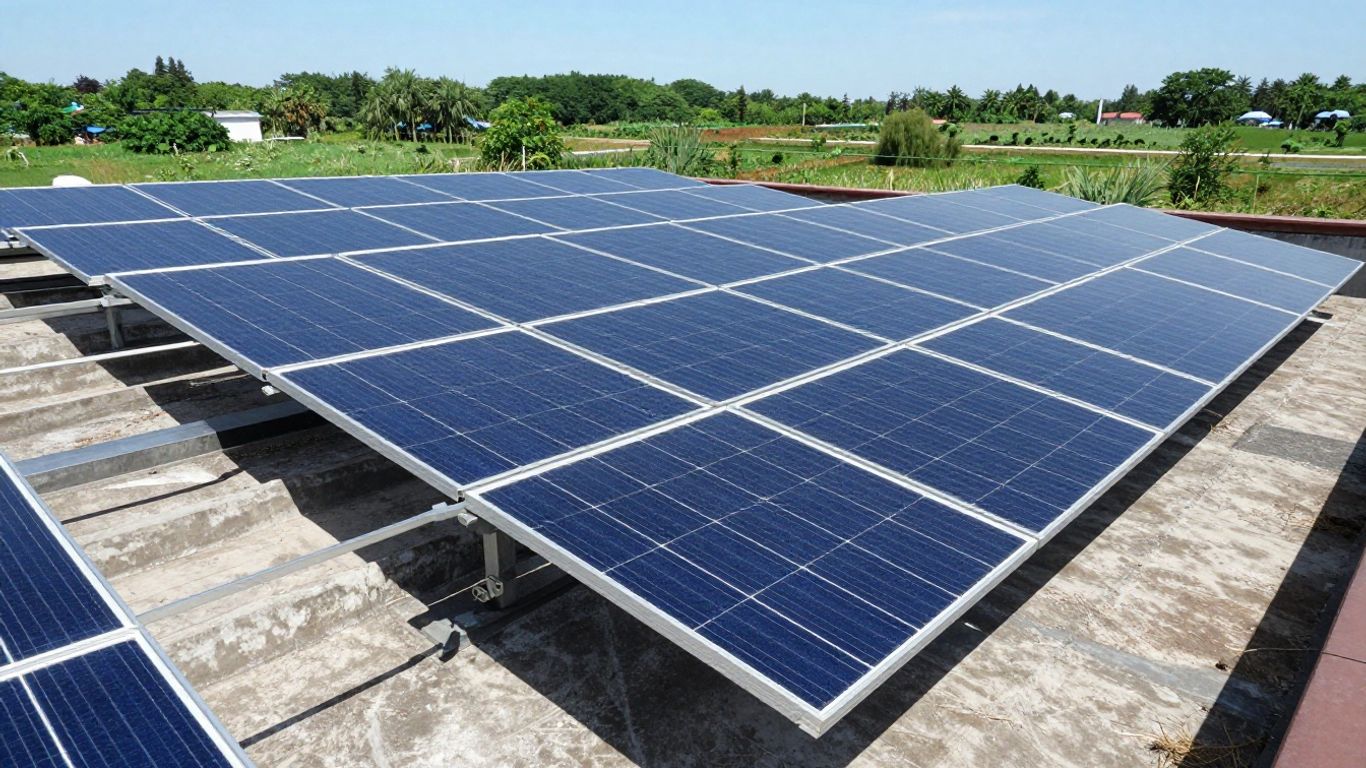
Polycrystalline solar panels, also called multicrystalline, represent a well-established technology in the photovoltaic field. Unlike monocrystalline panels which use a single silicon crystal, polycrystalline panels are manufactured from fragments of silicon melted together and then recrystallised. This manufacturing process, which is less complex and therefore less expensive, results in a cell structure composed of multiple crystals. Visually, this translates into a speckled appearance, often blue in colour, which distinguishes them from the more uniform-looking monocrystalline panels.
Their manufacturing involves pouring molten silicon into a mould, then allowing it to cool before cutting it into wafers. This method, although more economical, creates boundaries between the crystals. These boundaries can hinder the flow of electrons, which explains why their efficiency is generally slightly lower than that of monocrystalline panels. However, for many installations, this performance gap is largely compensated by their significant economic advantage.
The lower production cost of polycrystalline panels makes them particularly attractive for projects where budget is a major consideration. They offer a good balance between performance and financial accessibility.
Advantages of Polycrystalline Panels
Polycrystalline panels offer several advantages that explain their popularity, particularly in the French market. Their main advantage lies in their competitive price-quality ratio. They are generally cheaper to purchase than their monocrystalline counterparts, which reduces the overall cost of a solar installation. This financial accessibility makes them a prime choice for many individuals and businesses wishing to invest in solar energy without committing too large a budget.
Here are some of the strengths of polycrystalline panels:
- Affordable cost: Their less expensive manufacturing process is reflected in the final price, making them more accessible.
- Faster production: The manufacturing method is simpler and takes less time, contributing to their lower cost.
- Good overall performance: Although slightly less efficient than monocrystalline panels, they provide reliable and sufficient electricity production for most residential and commercial needs.
Their faster production is a key factor in their lower cost. They are an interesting option for those looking to equip a large area without panel efficiency being the absolute priority. For more information on different technologies, you can consult monocrystalline solar panels.
Applications of Polycrystalline Panels
Thanks to their more affordable cost, polycrystalline panels find their place in a wide variety of applications. They are particularly well-suited for projects where the available installation space is not a major constraint and where budget optimisation is paramount. They are therefore frequently found on the roofs of individual homes, agricultural buildings, and industrial hangars. Their efficiency, although slightly lower than that of monocrystalline panels, remains perfectly satisfactory for covering a significant portion of a household’s or business’s energy needs.
These panels are a pragmatic solution for many installations, especially when one wishes to install a large total capacity without the cost per peak watt becoming prohibitive. They are an accessible entry point into the world of solar energy for many consumers. Their speckled blue appearance, although less
Thin-Film Photovoltaic Solar Panels
Thin-film solar panels represent a distinct category in the landscape of photovoltaic technologies. Unlike traditional crystalline silicon-based panels, these are manufactured by depositing a thin layer of semiconductor material onto a substrate. This substrate can be glass, plastic, or even metal, giving these panels remarkable flexibility and lightness.
Understanding Thin-Film Panels
The basic principle of thin-film panels lies in the use of reduced amounts of semiconductor material. This material is applied in one or more very thin layers onto a support. This manufacturing method reduces the amount of raw material needed and, potentially, production costs. Furthermore, the inherent flexibility of some of these panels opens the way for applications where rigid panels would not be suitable.
Materials Used in Thin-Film Panels
Several types of semiconductor materials are used in the manufacture of thin-film panels. Among the most common are cadmium telluride (CdTe), copper indium gallium selenide (CIGS), and amorphous silicon (a-Si). Each material has its own characteristics in terms of efficiency, production cost, and durability. For example, CdTe is valued for its good cost-effectiveness, while CIGS can offer higher yields. Amorphous silicon, on the other hand, is often used in applications where flexibility is paramount.
Advantages of Thin-Film Panels
One of the main advantages of thin-film panels is their lightness and flexibility. This characteristic makes them ideal for installation on various surfaces, including curved structures or roofs that could not support the weight of more conventional panels. They are also often easier to transport and install, which can reduce labour costs. Although their efficiency is generally lower than that of monocrystalline or polycrystalline panels, their potentially lower manufacturing cost and their adaptability to specific uses make them an interesting option for many projects. They can be particularly useful for large-scale installations or for mobile applications, such as camping solar panels or portable devices for electricity supply on the go.
The simplicity of manufacturing and the reduction in materials used are key factors that differentiate thin-film panels from more established technologies. Their potential for continuous innovation in material selection and deposition processes promises to further improve their performance and range of applications.
Heterojunction (HJT) Solar Panel Technology
Understanding Monocrystalline Solar Panels
Heterojunction solar panels, often abbreviated as HJT, represent a significant advancement in the field of photovoltaics. They combine the best of two worlds: the reliability of crystalline silicon and the performance of thin films. Specifically, an HJT cell consists of a monocrystalline silicon base onto which very thin layers of amorphous silicon are deposited. This multi-layer structure is not insignificant; it significantly reduces the energy losses that usually occur during the conversion of light into electricity. Electrons generated by photon absorption are better guided and collected, resulting in increased efficiency, even in less ideal conditions.
Advantages of Monocrystalline Panels
One of the major advantages of HJT panels lies in their excellent efficiency. They display energy conversion rates that often exceed 24%, which is higher than many other technologies on the market. Furthermore, their performance is less affected by heat. While most panels see their efficiency decrease as temperature rises, HJT panels maintain better efficiency, which is a significant advantage in hot regions or during summer days. Their durability is also a strong point, comparable to that of traditional monocrystalline panels. They are designed to withstand weather conditions and maintain their performance over the long term. This combination of high efficiency, good thermal performance, and longevity makes them a very attractive option for those looking to maximise their solar energy production. HJT panels are a promising technology for the future of solar energy.
Applications of Monocrystalline Panels
Thanks to their high performance and good heat tolerance, HJT panels find their place in a variety of applications. They are particularly suitable for residential and commercial installations where space is limited and where the goal is to obtain maximum electricity production per square metre. Their efficiency in low-light conditions also makes them relevant for regions where sunlight is not always optimal. They are also found in projects requiring absolute reliability and stable energy production over many years. In summary, HJT panels are a prime choice for installations that demand the best in terms of efficiency and durability.
TOPCon Solar Panel Technology
Understanding TOPCon Technology
TOPCon technology, which stands for Tunnel Oxide Passivated Contact, represents a significant advancement in the field of photovoltaic solar panels. It focuses on improving the structure of solar cells to minimise energy losses. Essentially, it is an evolution of N-type cells, which are already known for their good performance. The main idea is to add an ultra-thin oxide layer and a doped polycrystalline silicon layer to the rear side of the cell. This combination acts as a highly effective barrier against electron recombination, a phenomenon that reduces the efficiency of conventional solar panels. This optimisation allows for more efficient capture and conversion of sunlight into electricity.
Optimising Energy Capture
One of the strengths of TOPCon technology lies in its ability to improve light capture, even in less ideal conditions. The special passivation layer helps reduce energy losses that normally occur at the back of the cell. This means that even when sunlight is not perfectly direct or the panel is slightly shaded, electricity production remains more stable. Furthermore, this technology reduces losses due to electrical resistance, another factor that can decrease overall performance. TOPCon panels are therefore designed to offer more consistent efficiency throughout the day and year.
Efficiency of TOPCon Panels
Solar panels equipped with TOPCon technology generally display higher efficiencies than older technologies like PERC. Efficiencies are often observed between 21% and 23%, or even higher for the most advanced models. This performance gain is directly linked to the reduction in losses mentioned previously. In addition to their efficiency, these panels have a good temperature coefficient, meaning they lose less performance as the temperature rises, a significant advantage during hot summer days. Their cost is generally considered moderate, offering a good balance between performance and investment.
PERC Solar Panel Technology
Principle of the PERC Passivation Layer
PERC solar panels, which stands for « Passivated Emitter and Rear Cell, » represent a notable evolution in photovoltaic technology. The main innovation lies in the addition of a passivation layer on the rear side of the solar cells. This layer has a dual role: it reduces electron recombination, meaning less energy is lost, and it reflects light that has not been absorbed on the first pass. This ability to send light back to the cell allows for a second chance of conversion into electricity.
Improved Light Capture
Thanks to this passivation layer, PERC panels are more efficient, especially in low-light conditions or when light is reflected. They are particularly effective at capturing red light, a part of the solar spectrum that traditional panels tend to convert into heat rather than electricity. By better capturing this light, PERC panels increase their overall efficiency. It can be considered that this technology allows for more energy to be recovered from the sun.
Increased Performance of PERC Panels
PERC panels generally offer higher efficiency than standard solar panels. Efficiencies often exceed 20%. This performance improvement translates into greater energy production for the same installed area. This can be a determining factor for installations where space is limited. The cost of PERC panels has become more affordable over time, making them an attractive option for many projects. For example, the cost of a solar installation can vary considerably, and choosing a technology like PERC can influence the overall budget of your project.
The integration of the rear passivation layer is a relatively simple modification but has a significant impact on the performance of solar cells. It improves electron management and optimises light absorption, leading to higher energy production.
Bifacial Photovoltaic Solar Panels
How Bifacial Panels Work
Bifacial solar panels are distinguished by their ability to capture sunlight on both sides. Unlike traditional panels that only utilise direct light falling on their front side, bifacial panels also use light reflected from the ground, rooftops, or other surrounding surfaces. This dual capture can potentially increase energy production significantly. They are often constructed with two layers of glass, one on the front and one on the rear of the cells, which improves their durability and weather resistance.
Advantages of Double-Sided Capture
The main advantage of bifacial panels lies in their increased energy yield. By capturing reflected light, they can produce more electricity per installed surface area. This makes them particularly interesting in environments where light reflection is significant, such as light-coloured ground, white roofs, or snowy areas. Furthermore, their robust design, often double-glazed, gives them greater longevity and better resistance to environmental stresses. They are an interesting option for optimising energy production in specific conditions.
Use Cases for Bifacial Panels
Bifacial panels find their use in various installation configurations. They are often mounted on elevated or tilted structures, allowing for maximum exposure to reflected light, which is ideal for large ground-mounted installations. They can also be integrated into pergolas or canopies, producing electricity while providing shade. In regions where snow is frequent, the ability to capture light reflected by snow can maintain energy production even in winter. The installation of these panels can be optimised with a good mounting system that ensures their stability and orientation. The market for bifacial solar panels is experiencing notable growth, driven by the search for increased energy production and by technological advancements that improve their efficiency. The adoption of these panels is a step towards more efficient and versatile solar energy production.
Thermal Solar Panels

Unlike their photovoltaic counterparts which produce electricity, thermal solar panels focus on heat production. Their role is to capture the sun’s energy to heat a fluid, usually water or an antifreeze mixture. This heated fluid then circulates through a system to supply your domestic heating system or to produce domestic hot water. It’s a direct way to utilise solar energy for thermal needs.
Principle of Heat Conversion
The operation relies on a collector, often a dark-coloured metal plate, which absorbs solar radiation. This absorption transforms light energy into heat. This heat is then transferred to a heat transfer fluid circulating in pipes integrated into the panel. Once heated, this fluid is sent to a storage tank or directly to the heating system. It is important to note that these panels do not produce electricity and therefore do not require a solar charge controller.
Applications of Solar Heating
The main applications of thermal solar panels are water heating and building heating. They are particularly effective for producing domestic hot water, thus reducing reliance on fossil fuels for this common use. They can also contribute to space heating, as a supplement to an existing system, allowing for substantial savings on energy bills. The sizing of the installation will depend on your specific heating needs and the available space for installing the collectors. For an accurate estimate of costs and available aid, it is advisable to consult a professional and use an online simulator, in order to benefit from government aid by choosing an RGE certified installer RGE.
How Thermal Collectors Work
Thermal collectors generally consist of several key components. There is an absorber plate, often made of black metal, which maximises the capture of solar heat. This plate is surrounded by piping through which the heat transfer fluid circulates. The assembly is protected by a transparent glass cover, which allows solar radiation to enter while limiting heat loss through radiation and convection. Thermal insulation at the back of the collector minimises heat loss to the external environment. These components work together to transfer maximum solar energy to the heat transfer fluid.
The efficiency of a thermal solar panel lies in its ability to absorb and retain solar heat, then transfer it to a fluid for direct use. It is a proven technology for renewable heat production.
Hybrid Solar Panels
Hybrid solar panels represent an innovative approach in the field of renewable energy, as they combine two essential functions in a single device: electricity production and heat generation. This technology seeks to maximise the use of the solar capture surface by utilising both direct radiation for photovoltaics and the heat generated for thermal purposes.
Combining Photovoltaics and Thermal
At the heart of hybrid technology is the integration of photovoltaic cells, similar to those in conventional panels, and a thermal collector system. The latter typically uses a heat transfer fluid that circulates behind the photovoltaic panel. When solar cells produce electricity, they also generate heat. The thermal system captures this residual heat, as well as heat directly absorbed by the panel, to heat the fluid. This fluid can then be used for domestic heating or domestic hot water production. The goal is to make the best use of every sunbeam, producing both electrons and calories. Current research aims to improve the efficiency of this dual conversion, particularly by managing the temperature of photovoltaic cells, as excessive heat can sometimes reduce their electrical performance. Hybrid solar panels are an interesting solution for installations where space is limited, as they allow for optimised energy production over a reduced area. They are particularly relevant in regions where heating needs are significant, as shown by advances in Sweden.
Advantages of Dual Production
The main advantage of hybrid panels lies in their ability to offer dual energy production. This means that a single installation can meet two distinct energy needs, thereby reducing the number of systems to install and potentially the overall cost. By combining photovoltaics and thermal, an overall increase in energy efficiency can be observed compared to installing two separate systems on the same surface. Furthermore, by utilising the heat often lost by conventional photovoltaic panels, their overall performance is improved. These panels are designed for increased durability, often with weather-resistant materials, making them a long-term investment for homeowners concerned about their energy consumption and environmental impact. They can be an excellent option for individual homes or small commercial buildings looking to reduce their reliance on fossil fuels.
Space Optimisation with Hybrid Panels
Space optimisation is a major asset of hybrid solar panels. In urban areas or on rooftops with limited dimensions, installing both photovoltaic and thermal panels can be complex, if not impossible. Hybrid panels solve this problem by integrating both technologies into a single product. This allows for maximising energy production on a given surface, making solar energy accessible even in contexts where space is a constraint. For example, a 150 kW installation can be carried out more efficiently with hybrid panels if heat needs are also present. This approach reduces the ground or roof footprint while increasing the overall energy yield of the installation. It is an intelligent solution for those who want versatile energy production without compromising aesthetics or available space.
Hybrid solar panels are a promising technology that merges electricity and heat production, thus offering a more comprehensive and efficient energy solution for buildings. Their ability to optimise space utilisation and valorise residual heat makes them a relevant choice for a successful energy transition.
Back Contact Solar Panels
Structure of Back Contact Cells
Back contact solar panels, often called « back contact, » represent a notable evolution in photovoltaic cell design. The main characteristic of this technology lies in the relocation of all electrical connections, called « busbars, » to the rear side of the cell. Unlike more traditional technologies where these contacts are visible on the front side and can obscure part of the active surface, the « back contact » design completely frees up the front side. This allows for greater absorption of sunlight and thus better conversion into electricity. The cells are generally made from high-purity monocrystalline silicon, which contributes to their overall performance. This structural approach aims to maximise the surface exposed to the sun and minimise energy losses.
Advantages in Terms of Efficiency
The main advantage of « back contact » panels lies in their superior efficiency. By eliminating front busbars, shading on the cell is reduced, which increases the amount of sunlight captured. Furthermore, the arrangement of the rear contacts optimises the path taken by electrons, thus reducing resistance losses. These panels are known for their excellent performance, even in low-light conditions or at high temperatures, where other technologies may show a drop in output. They offer an energy conversion efficiency that can reach very competitive levels on the market, positioning them as a premium option for demanding installations. This advanced design ensures more stable and greater energy production in the long term.
Applications of Back Contact Panels
Thanks to their high efficiency and clean aesthetics (no visible metal grid on the front side), back contact solar panels find their place in a variety of applications. They are particularly appreciated for residential installations where aesthetics play a role, as well as for commercial and industrial projects where maximising energy production on a given surface is paramount. They are also found in contexts where space is limited, such as on building roofs or in high-density ground-mounted solar installations. Their ability to maintain good performance in various environmental conditions also makes them suitable for regions where sunlight can be variable. These panels are a prime choice for those seeking cutting-edge solar technology and optimal energy production.
The engineering behind « back contact » panels focuses on eliminating obstacles to light capture and electron flow. Every design detail aims to improve the overall efficiency of the panel, thus offering a more performant energy solution.
Conclusion
To summarise, there are now several types of solar panels, each with its own advantages and limitations. Between monocrystalline, polycrystalline, thin-film, bifacial, or even hybrid panels, the choice mainly depends on your budget, available space, and energy needs. Technologies are evolving rapidly, and it’s not always easy to keep up. But one thing is certain: investing in solar is investing in clean and sustainable energy. Before you start, take the time to compare options and seek advice from a professional. This will save you many surprises and help you make the most of your solar installation.
Frequently Asked Questions
What is a photovoltaic solar panel?
A photovoltaic solar panel is a device that converts sunlight into electricity. It works thanks to special cells that capture solar energy and change it into usable electrical current for the home.
What is the difference between a monocrystalline and a polycrystalline panel?
Monocrystalline panels are made from a single silicon crystal, giving them higher efficiency and a uniform black colour. Polycrystalline panels, on the other hand, are made from several mixed crystals, which often makes them blue and slightly less efficient, but they are also cheaper.
What are thin-film panels used for?
Thin-film panels are lighter and more flexible than other types. They are used for large areas or on roofs that cannot support much weight. They are also suitable for installations where the roof shape is special.
How does a thermal solar panel work?
A thermal solar panel captures the sun’s heat to transfer it to a liquid, like water. This heat is then used to heat domestic hot water or the air in the house, but it does not produce electricity.
What is a hybrid solar panel?
A hybrid solar panel combines two technologies: it produces both electricity using photovoltaic cells and heat using a thermal collector. This allows for maximum utilisation of solar energy over the same surface.
Are bifacial solar panels more efficient?
Yes, bifacial solar panels capture sunlight from both sides, allowing them to produce more electricity, especially if light reflects off the ground or snow around the panel.
What is PERC technology in solar panels?
PERC technology adds a special layer to the back of solar cells. This layer reflects unabsorbed light so it can be used a second time, which improves the panel’s efficiency.
Are all solar panels suitable for all homes?
No, the choice of panel type depends on several factors such as roof size, orientation, budget, and energy needs. It is important to compare options carefully to choose the most suitable solution for each situation.