Installing solar panels for self-consumption is a smart move to reduce your electricity bills. But to get the most out of them, simply placing them anywhere isn’t enough. The orientation of your self-consumption solar panels plays a major role in the amount of energy you can produce and therefore consume directly. This guide helps you understand how to optimise their placement to maximise your yield, taking all factors into account.
Key Takeaways
- A south-facing orientation is often considered ideal for maximising annual solar production, but south-east and south-west orientations offer very efficient alternatives with minimal yield loss, often less than 15%.
- The tilt of the panels is as important as their orientation. An angle between 25° and 35° is generally optimal for balanced annual production, although adjustments can be made to favour winter or summer production.
- Shading, whether from trees, chimneys, or neighbouring buildings, is the main enemy of solar production. Solutions like micro-inverters can mitigate their impact by optimising the performance of each panel individually.
- For self-consumption, an East-West orientation can be more advantageous than a simple South, as it smooths out electricity production over a larger part of the day, better synchronised with daily consumption needs.
- The actual yield of an installation depends on many factors, including local sunshine, temperature (which can reduce cell efficiency), panel cleanliness, and installation quality. Regular monitoring and simple maintenance can maintain optimal performance in the long term.
Understanding the Importance of Orientation for Self-Consumption
Why is the orientation of your solar panels crucial?
The orientation of a solar panel is a bit like choosing the best spot for your houseplant so it receives as much light as possible. For photovoltaic panels, it directly determines the amount of solar radiation they capture throughout the day and year. The more perpendicular the photovoltaic cells are exposed to the sun’s rays, the more electricity they produce. It’s a simple rule but has a major impact on the overall performance of your installation. A well-thought-out orientation can make a noticeable difference in your annual energy production.
Direct Impact on Your Annual Production
The effect of orientation on your installation’s yield should not be underestimated. For the same installed capacity, say 3 kWp, optimal orientation can allow for the production of between 3,500 and 4,500 kWh per year. This represents a substantial difference, which translates into additional savings on your electricity bills over the lifespan of your system. Thinking about orientation from the outset ensures you get the most out of your solar investment.
Orientation, a Determining Factor in Performance
Contrary to popular belief, facing directly south isn’t always the ideal solution. Depending on your consumption profile, i.e., when you use the most electricity at home, a different orientation could prove more advantageous. For example, if you are often at home during the day, south will be perfect. But if you are more active in the morning and evening, East-West orientations might better suit your needs. It’s about finding the best balance between energy production and its effective use, in order to maximise your self-consumption rate. The goal is to produce electricity when you need it, rather than feeding it back into the grid at a potentially less attractive rate. A personalised study can help you see more clearly, taking all these elements into account for your self-consumption solar kit project.
The ideal orientation is not just the one that produces the most theoretical energy, but the one that best aligns solar production with your consumption habits, thereby reducing your dependence on the traditional electricity grid.
Optimising Orientation for Maximum Solar Yield
The orientation of your solar panels is a key element in maximising electricity production. While facing directly south is often presented as the theoretical ideal, other configurations can be just as efficient, if not more so, depending on your consumption profile.
South-Facing: The Theoretical Ideal
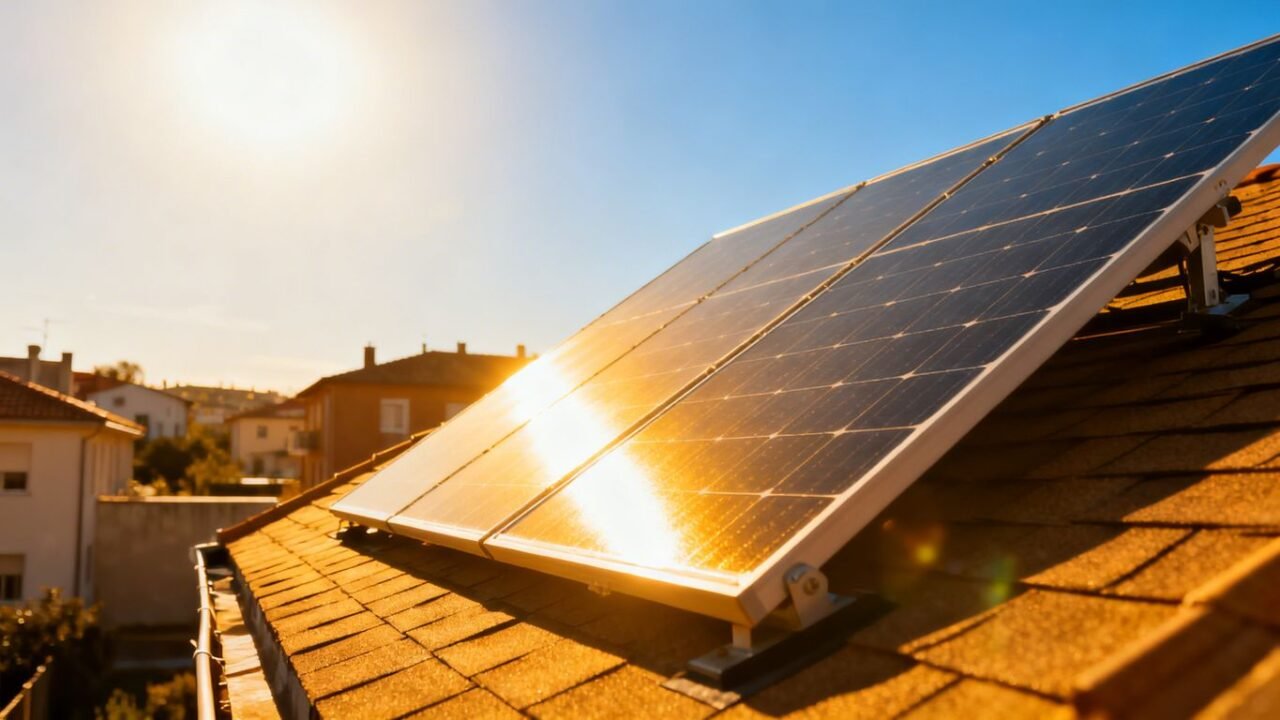
A south-facing orientation allows for the capture of maximum solar radiation throughout the day, especially during the hours when the sun is highest in the sky. This is the position that offers the most potential for maximum annual production. For a residential installation, facing south is generally the first recommendation to obtain the most energy possible to maximise the performance of your solar kit.
South-East and South-West Orientations: Efficient Alternatives
If a south-facing orientation is not possible due to the configuration of your roof or obstacles, south-east and south-west orientations remain excellent options. They allow for the capture of a significant amount of solar energy, with a yield loss often less than 15% compared to a perfect south orientation. A south-east orientation will favour morning production, while south-west will be more efficient in the afternoon. This distribution can be interesting for smoothing out production over the day.
The Impact of East, West, and North Orientations on Production
East and West orientations, while less productive than South, can be interesting in a self-consumption strategy. They allow for better synchronisation of electricity production with consumption times, particularly in the morning and late afternoon. An installation split between East and West can thus reduce the need to feed surplus into the grid or resort to storage. North orientation is the least favourable, as it receives less direct light. However, even in this case, diffuse light can still allow for production, albeit significantly reduced. It is important to consider these aspects when choosing the configuration best suited to your specific needs.
Here is an overview of comparative yields according to orientation and tilt, considering a South orientation with a 30° tilt as a reference (100%):
| Orientation | 30° Tilt | 45° Tilt | 0° Tilt (Horizontal) |
|---|---|---|---|
| South | 100% | 97% | 93% |
| South-East / South-West | 95% | 93% | 89% |
| East / West | 82-85% | 78-82% | 75-78% |
| North-East / North-West | 70-75% | 68-72% | 65-68% |
| North | 60% | 55% | 50% |
It is essential to note that these percentages are indicative. Actual performance will depend on many factors, including installation quality and local weather conditions.
Tilt: An Indispensable Complement to Orientation
If orientation gives the direction, tilt adjusts the angle of your panels relative to the ground. It’s a bit like adjusting the brim of your cap to see the sun better. Together, orientation and tilt form the winning duo for your solar panels to capture maximum energy.
Optimal Tilt for Annual Yield
For electricity production that is constant throughout the year, a tilt angle of between 30 and 35 degrees is generally considered the best compromise in France. This angle effectively captures the sun’s rays, whether the sun is high in the sky in summer or lower on the horizon in winter. It’s an average that aims to smooth out production over the twelve months. Thinking about this tilt is already optimising your annual solar yield.
Adapting Tilt to Seasons: Winter vs. Summer
The sun’s position changes drastically between winter and summer. In winter, the sun is low, and more glancing rays hit the panels. To make the most of them, a steeper tilt, say between 45 and 60 degrees, would be ideal. Conversely, in summer, the sun is high in the sky, almost vertical. A lower tilt, or even zero (flat panels), would then be more advantageous for capturing these direct rays. Of course, installing systems that change angle according to the season is technically possible, but it represents an additional cost that is often difficult to justify for individuals.
Tilt Compromises for Specific Roofs
In most cases, solar panels are installed on an existing roof. The tilt of this roof often dictates the angle of the panels. If your roof is already tilted at 30 degrees, that’s perfect! But if not, mounting structures will be needed to adjust the angle. Sometimes, available space or roof configuration does not allow for the ideal tilt. In these situations, a slight loss in production must be accepted, but it often remains much more interesting than doing nothing. The important thing is to find the best possible balance.
Tilt is not just a matter of numbers; it’s a physical adaptation of your panels to the sun’s path. A well-thought-out angle, even if not perfect, makes a real difference in the amount of electricity produced each day.
Managing Shading to Preserve Solar Production
Shading: The Number One Enemy of Photovoltaics
Even slight shading can degrade the output of an entire solar installation. Shade doesn’t just reduce the power of a single panel; when they are in series, the entire string can lose efficiency. A tree, a chimney, or even an antenna cable casting its shadow on your modules at the wrong time of day can cancel out hours of solar production without you realising it immediately. In France, it is estimated that a panel shaded by only 10% of its surface can lead to a 30% to 50% loss on a string not equipped with optimisers.
Identifying and Anticipating Sources of Shading
To avoid unpleasant surprises, take the time to examine what surrounds your roof:
- Trees: Consider future growth and shade in winter and summer.
- Chimneys and antennas: They often cast a moving shadow, especially in the morning or evening.
- Neighbouring buildings: In urban areas, shade can vary enormously depending on the season and the sun’s position.
A good habit is to map the projected shade over a full year. Tools like PVGIS offer realistic simulations and help choose the least affected roof area.
From the design stage of the installation, a twelve-month shading analysis can prevent many future disappointments and optimise every kWh produced.
Technical Solutions to Minimise the Impact of Shadows
Fortunately, there are now solutions to limit the effect of partial shading on your solar production:
- Micro-inverters: Each panel produces independently, so if one is affected by shade, the others continue normally.
- Power optimisers: They allow for maximum extraction from each panel, even in case of localised shade.
- Strategic positioning: Install panels where exposure is longest, even if it means dividing the installation across two different roof slopes to choose the best combination.
Here is a table illustrating the average production loss according to the type of shading:
| Source of Shade | Estimated Impact (Losses) |
|---|---|
| Tree (10% surface, series) | 30–50% |
| Chimney (1 m²) | 5–10% on strings |
| Neighbouring building | Variable (depending on season, can be up to 40%) |
Do not underestimate the importance of analysis: a few hours of planning and the addition of technical optimisations can make a difference to the real profitability of your solar system. You can consult the analysis of production capacity by region, which offers a numerical view of expected yields in France per kilowatt installed, on annual production by region.
Adapting Orientation to Your Consumption Profile
The orientation of solar panels is not decided solely based on theory or a search for maximum production. It must first and foremost correspond to your consumption habits to optimise the self-consumption rate and maximise the economic benefit of your installation.
The Myth of the Solely South-Facing: When East-West Becomes More Profitable
We often hear that a south-facing orientation is the only valid one. However, an East-West facing solar installation can, depending on the case, offer a better economic return for certain profiles. This distribution of orientation smooths out production throughout the day, aligns with morning and evening peaks, and avoids unused production peaks at midday.
- « Constant Presence » Profile (remote work, retired): South orientation remains interesting, production naturally coincides with consumption, leading to a high self-consumption rate (60-75%).
- « Active/House Empty During the Day » Profile: An East-West installation is often more suitable as it follows your needs in the morning before leaving and in the evening upon returning. The annual yield is slightly lower (see details on typical performance of a south-east or south-west facing photovoltaic kit), but the savings realised can be higher because you self-consume more.
- « Total Sale » Profile: Here, pure south at 30° remains the best option to « feed » the maximum amount of electricity into the grid, without considering consumption times.
In practice, there is no universal solution. What matters is adjusting the strategy to your actual lifestyle to avoid the current being sold to the grid at a low price.
Synchronising Production and Consumption for a Better Self-Consumption Rate
To maximise self-consumption, it is important that the solar production curve coincides with the hours when you consume the most. Here are some guidelines for adapting the orientation:
- If you consume most in the morning (breakfast, getting ready), favour an East orientation.
- If you are mainly at home in the late afternoon and evening, a West orientation should be favoured.
- Those present all day, including at midday (cooking, appliances running), will benefit from a south-facing orientation.
A typical adaptation strategy: install the maximum number of panels facing south if possible and supplement, depending on available space, with an East or West facing section to capture energy from sunrise to sunset.
Benefits of East-West Orientation for Daily Consumption
The East-West orientation offers several concrete benefits for self-consumption:
- Production better distributed between 6 am and 8 pm.
- Less surplus fed into the grid at low prices.
- Covers the two consumption peaks of the household (morning/evening).
Comparative table of typical yields by orientation (based on South yield 100%):
| Orientation | Annual Yield (%) |
|---|---|
| South | 100 |
| South-East/South-West | 95 |
| East/West | 82-85 |
| North | 60 |
This choice is neither definitive nor dogmatic. For certain specific profiles, it is often worth requesting a study to determine the real gain according to your consumption patterns and available roof space. For more information on optimisation, find best self-consumption orientation practices, adapted to each situation.
Analysing Yields According to Orientation Configurations
Comparative Table of Yields by Orientation and Tilt
The orientation and tilt of your solar panels are two inseparable parameters that dictate the amount of solar energy captured. While facing directly south is often cited as the theoretical ideal, it is important to understand how other orientations and different tilt angles concretely affect your production.
Here is an overview of comparative yields for different configurations. These percentages are based on a South orientation with a 30° tilt as a reference (100%).
| Orientation | 30° Tilt | 45° Tilt | 0° Tilt (Horizontal) |
|---|---|---|---|
| South | 100% | 97% | 93% |
| South-East / South-West | 95% | 93% | 89% |
| East / West | 82-85% | 78-82% | 75-78% |
| North-East / North-West | 70-75% | 68-72% | 65-68% |
| North | 60% | 55% | 50% |
Understanding Yield Percentages
These figures are not mere estimates; they represent a direct loss in production compared to an optimal situation. For example, an East-facing installation with a 30° tilt will produce approximately 15% less in kWh than an identical South-facing installation. This directly translates into non-produced kilowatt-hours (kWh) and, consequently, reduced potential savings on your electricity bill. It is therefore essential to choose the orientation of your solar panels wisely based on your geographical location and roof configuration.
Calculating Potential Production Losses
To estimate your losses, simply multiply the expected annual production under ideal conditions by the percentage loss corresponding to your configuration. For example, if your 3 kWp installation is estimated to produce 3600 kWh/year facing South at 30°, an East orientation with a 30° tilt could generate approximately 3600 * 0.85 = 3060 kWh/year. The difference of 540 kWh represents the annual production loss. This analysis allows for a better understanding of your project’s profitability and for adjusting your expectations. It should also be considered that even a perfect orientation can be affected by shading, further reducing overall yield.
Environmental Factors Influencing Yield
Sunshine and Climate: A Geographical Influence
Where you live has a direct impact on the amount of energy your solar panels can produce. Southern France, for example, benefits from more generous sunshine throughout the year, resulting in a higher annual yield. But be careful, even in regions with less sunshine, modern panels are designed to capture diffuse light. This means they can still produce electricity, even on cloudy days. It’s a bit like having a flashlight that works even when there’s no direct sun. Geography is therefore a key element to consider from the outset.
Temperature and Thermal Losses: The Effect of Heat on Cells
One might think that the hotter it is, the more panels produce. Well, it’s quite the opposite! Photovoltaic cells have an ideal temperature range for optimal performance. Above 25°C, their efficiency begins to decrease. For every additional degree, production can be lost by 0.3% to 0.5%. This is why good ventilation under the panels is so important. A well-ventilated panel dissipates heat better and maintains more stable performance than a panel stuck to the roof where air cannot circulate. Think of it like a computer: if it overheats, it slows down.
The Importance of Diffuse Light
Diffuse light is the light that reaches your panels without being directly from the sun. It is present on cloudy, foggy days, or even at dawn and dusk. Current solar panels are increasingly efficient at capturing this light. This allows for continued energy production even when the sky is not perfectly clear. This is a major asset, especially in regions where direct sunlight is not always available. This ability to use ambient light contributes to the profitability of your solar installation in the long term, ensuring more consistent production throughout the year.
The environment in which your panels are installed plays a significant role in their production. It’s not enough to have good orientation and tilt; you also need to consider climatic conditions and ambient temperature to anticipate yield variations.
Here is an overview of yields according to different configurations, although actual conditions may vary:
| Orientation | 30° Tilt | 45° Tilt | 0° Tilt (Horizontal) |
|---|---|---|---|
| South | 100% | 97% | 93% |
| South-East / South-West | 95% | 93% | 89% |
| East / West | 82-85% | 78-82% | 75-78% |
| North | 60% | 55% | 50% |
It is important to note that these percentages are indicative and represent a comparison to an ideal South orientation. Studying the factors influencing panel efficiency is therefore crucial for an accurate estimate.
Improving the Overall Yield of Your Solar Installation
Once your solar installation is in place, it’s not enough to just let it do its job. To ensure your investment remains profitable in the long term, a few simple but important actions should be considered. This involves keeping your system in good working order and monitoring its performance.
Regular Maintenance and Cleaning of Your Panels
Over time, dust, pollen, dead leaves, or even atmospheric pollution can accumulate on the surface of your panels. This film, even if thin, can reduce the amount of sunlight reaching the photovoltaic cells, and therefore decrease your electricity production. Annual cleaning, which is often sufficient, allows the panels to regain their full transparency and maintain optimal performance. It is advisable to do this in the spring, before the peak summer production period.
Monitoring Your Production for Optimal Responsiveness
It is essential to implement a system for monitoring your production. This allows you to see in real-time the amount of energy your panels are generating. If you notice a sudden or unusual drop in yield, you can quickly identify the cause. This could be a technical problem, recently appeared shading, or simply the need for cleaning. Prompt intervention can prevent significant production losses and ensure the profitability of your installation. This monitoring is key to maximising your self-consumption.
The Importance of Installation Quality
Although this primarily concerns the installation phase, the quality of the initial installation has a lasting impact on yield. An installation carried out by qualified professionals ensures that the panels are correctly oriented and tilted, and that the fixings are solid. Careful installation minimises the risk of technical failure and ensures that your system captures the maximum amount of sunlight possible throughout its lifespan. It is also important to ensure adequate ventilation under the panels to prevent overheating, which can also impair performance.
The Role of Storage and Management in Valuing Energy
Producing a lot of solar electricity is good. But if this energy is not used at the right time, its value decreases. The main goal of self-consumption is to use the energy you produce. If excess electricity is fed back into the grid at a low rate, the profitability of your installation can stagnate. Therefore, a way must be found to match your consumption with the times when your panels produce the most.
Difference Between Producing More and Consuming Better
One might think that more panels automatically mean more savings. This is not always the case. The actual effectiveness of your solar project depends on your ability to use this electricity at home. Without assistance, the self-consumption rate is often around 30% to 40%. This means a large portion of the energy produced is lost or sold at a low price.
Importance of the Self-Consumption Rate
The self-consumption rate measures the proportion of solar energy that you consume directly. Increasing this rate is key to maximising your savings. With management or storage solutions, it is possible to reach 70% to 85%. This significantly reduces your dependence on the traditional electricity supplier. For residential homes, aiming for a rate between 70% and 80% allows for a good balance between savings and installation costs. Higher targets are possible.
Solar Battery Storage to Maximise Savings
This is where storage comes in. A solar battery allows you to keep the excess energy produced during the day to use it in the evening or at night. Every kilowatt-hour stored is a kilowatt-hour you don’t need to buy. This directly transforms the yield of your panels into tangible savings on your electricity bill.
Here is an overview of available storage solutions:
- EcoFlow PowerOcean Single Phase: Ideal for common needs (lighting, refrigerator, TV), with up to 6 kW output and 15 kWh storage.
- EcoFlow PowerOcean (Three Phase): For larger needs like a heat pump or electric vehicle charger, with capacity up to 45 kWh.
- EcoFlow PowerOcean Plus (Three Phase): For very high consumption, with a 40 kW solar input and capacity up to 180 kWh.
For even finer management, systems like HEMS (Home Energy Management System) analyse your habits and optimise energy use in real-time. They help reduce losses and ensure that every watt produced is used in the most profitable way possible. It is this synergy between production, storage, and intelligent management that ensures the best long-term profitability.
Choosing the Right Self-Consumption Solar Panel Orientation
Evaluating Theoretical vs. Actual Yield
When we talk about orientation for solar panels, we often think of facing directly south. This is true, it’s the theoretical ideal for capturing maximum sun over the year. But in practice, especially for self-consumption, it’s not always the most profitable solution. You need to look at how your electricity consumption is distributed throughout the day. If you are often at home, south can be perfect. On the other hand, if you work outdoors and return in the evening, East and West facing panels might better suit your needs. They produce in the morning and afternoon, when you are there, rather than generating a surplus at midday that you won’t consume.
The Synergy Between Production, Storage, and Management
Orientation alone doesn’t do everything. To truly optimise your installation, you need to consider how the energy produced interacts with your consumption and, possibly, with a storage system. An East-West orientation, for example, can produce an interesting amount of energy in the morning and late afternoon. If you have a battery, this energy can be stored for use in the evening, when the sun is no longer shining. This increases your self-consumption rate, which is the proportion of electricity you produce and consume yourself. It’s like having your own small power plant that adapts to your lifestyle. Think of it as a puzzle where each piece (orientation, storage, consumption habits) must fit together for an optimal result.
The Long-Term Profitability of Your Solar Installation
Ultimately, the goal is to make your solar installation profitable over time. This means looking beyond simple gross production calculations. An orientation that is not perfectly south, but which better aligns production with your consumption hours, can prove more economical. For example, a 3 kWp East-West oriented installation might produce about 16% less in kWh than an identical south-facing installation. However, if this shifted production allows you to directly consume 50% more of your own electricity, the savings realised can largely offset this difference. It is therefore important to conduct a personalised study for your solar home, taking into account your consumption profile and the specificities of your roof. The components of your kit also play a role, but orientation remains a major lever for maximising your savings over the 25-year lifespan of the installation.
Conclusion: Orientation, a Key Factor but Not the Only One
In summary, the orientation and tilt of your solar panels play a major role in the amount of electricity you will produce each year. A south orientation is often best, but south-east or south-west can also work very well, with minimal yield loss. Don’t forget that even diffuse light helps with production. The ideal tilt is generally between 25 and 35 degrees for a good balance throughout the year, but this can be adjusted depending on whether you prioritise winter or summer. You also need to be mindful of shadows cast by trees or neighbouring buildings, as they can significantly reduce production. Micro-inverters can help mitigate these issues. Finally, consider the administrative steps, as a declaration is sometimes required. By combining good positioning, the right technology, and adhering to the rules, you maximise your chances of having a high-performing solar installation.
Frequently Asked Questions
What is the best orientation for my solar panels?
The ideal orientation to maximise electricity production is facing directly south. However, south-east and south-west orientations are also very efficient, with a yield loss often minimal, generally less than 15%. These orientations can even be more advantageous for self-consumption if they better match your consumption times.
Is the tilt of the panels as important as the orientation?
Yes, tilt is an essential complement to orientation. For optimal annual yield, a tilt between 25 and 35 degrees is generally recommended. A steeper tilt helps in winter when the sun is low, and a shallower tilt is better in summer when the sun is high.
Will shadows on my panels significantly reduce production?
Absolutely. Shadows, whether from trees, chimneys, or neighbouring buildings, are the main enemy of solar production. Even a small shadow on part of a panel can reduce the production of the entire string if the technology is not adapted. It is therefore crucial to carefully study shading areas before installation.
Can solar panels be installed if they are not facing directly south?
Yes, it is entirely possible and often profitable. East and West orientations allow for electricity production to be spread over a larger part of the day, which can better match your consumption habits. For example, East captures energy in the morning and West in the afternoon, thus covering the household’s needs more evenly.
What is the self-consumption rate and why is it important?
The self-consumption rate is the proportion of electricity that you produce yourself and consume directly in your home. The higher this rate, the less you need to buy electricity from the public grid, which increases your savings. Good orientation and intelligent management of your consumption help maximise this rate.
Is battery storage necessary to make my installation profitable?
Battery storage is not strictly mandatory, but it significantly improves profitability. It allows you to store excess energy produced during the day to use it in the evening or at night, when the sun is not shining. This increases your self-consumption rate and further reduces your electricity bill.
Does outdoor temperature affect solar panel performance?
Yes, paradoxically, excessive heat can reduce the efficiency of solar panels. Photovoltaic cells work best at a moderate temperature, around 25°C. Beyond that, their yield decreases slightly. This is why good ventilation under the panels is important.
How can I ensure my solar installation produces maximum energy?
To optimise yield, you need to choose the best possible orientation and tilt, avoid shading, and of course, regularly maintain your panels by cleaning them. Monitoring your production also allows you to quickly detect any problems and ensure consistent performance over the long term.